

In-line label and packaging inspection
Let a camera help check labels and codes on the line, once tested on real product
Start by surveying what people check by eye on the packing line, then assess a camera and lighting to check labels, printed codes and caps, with a reject signal, based on the pieces tested.
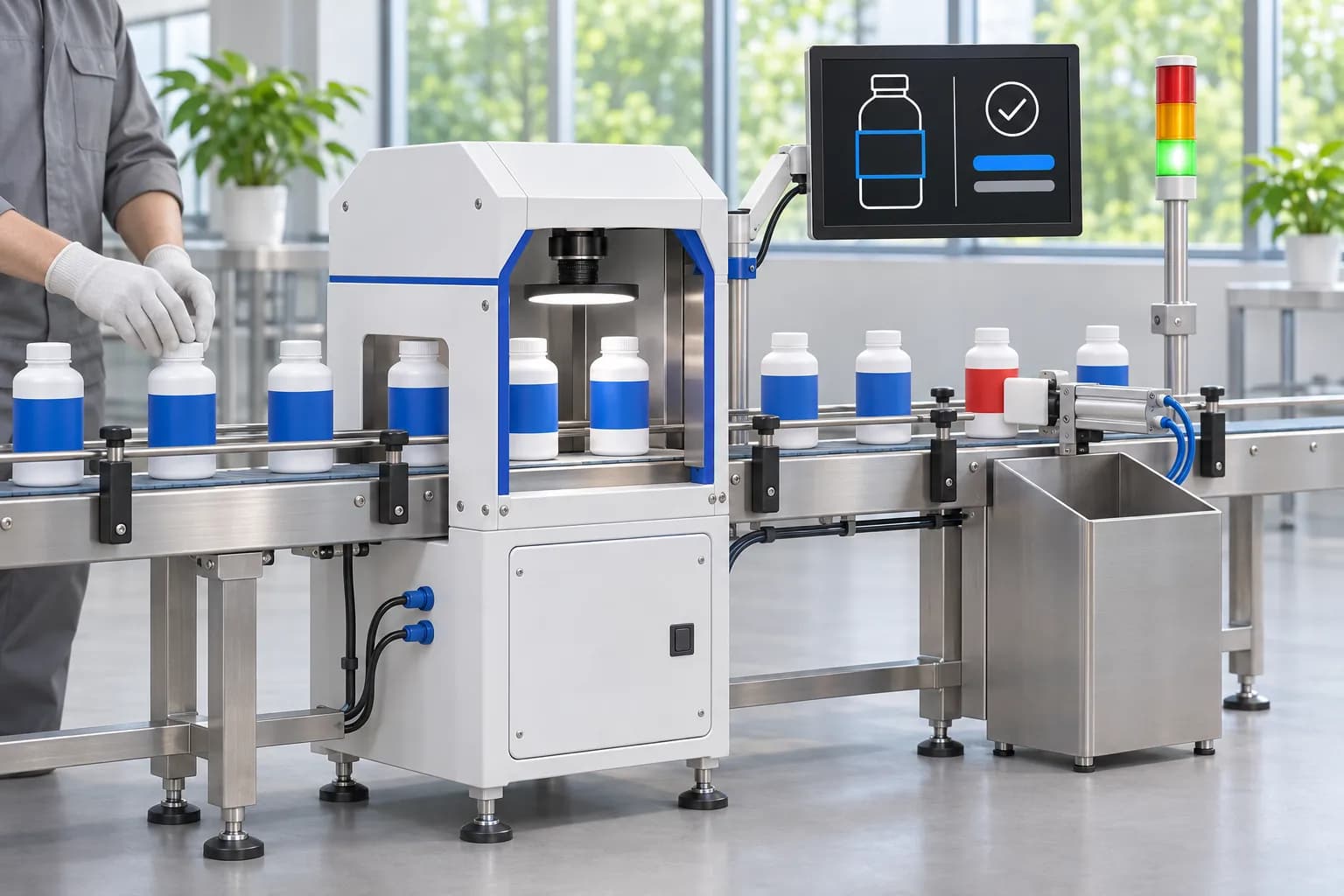
Before the system
Before adding a camera, find out what people check and where it slips
Today a worker may check by eye for skewed or torn labels, faint printed codes or missing caps. On a continuous line, fatigue and changing light make checking uneven, and no images are kept to look back on.
It is not easy to fix. Glossy or clear packaging reflects light differently from opaque boxes, and pieces that sit unevenly mean the camera may not see everything, so criteria are set only after testing real pieces.
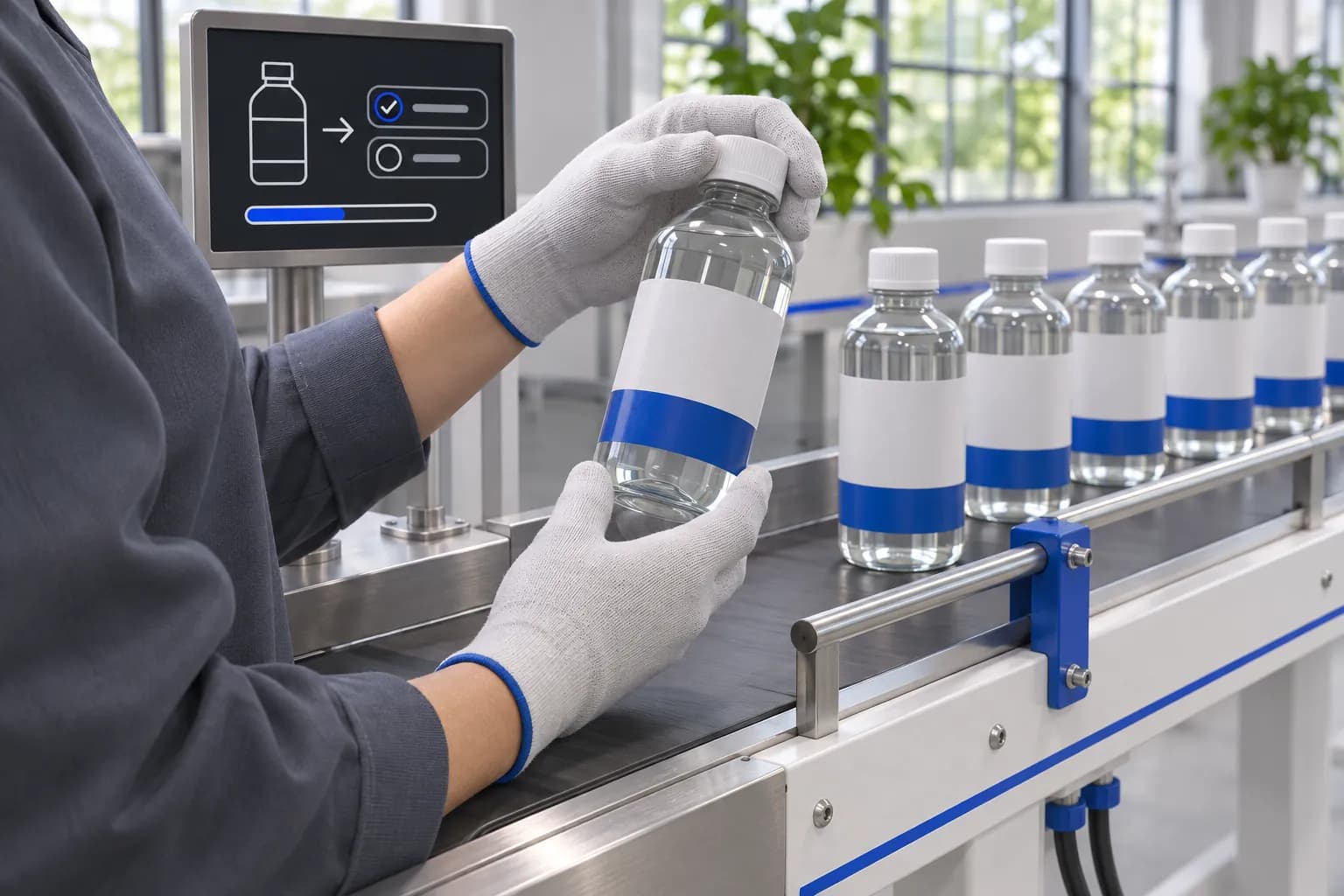
Where the system helps
Assess an in-line check point that inspects, signals and stores images of failed pieces
The concept image shows an inspection hood over the conveyor, with a camera and ring light above, a results screen, a status light tower, and a pusher that sends pieces into a bin beside the line.
The project agrees the checklist with the line supervisor, then tests with known good and bad samples. The supervisor decides what happens to rejected pieces and is responsible when a rejection is wrong.
How the work flows
- 01
Survey line and checklist
Look at mounting position, site lighting and what people check now.
- 02
Test with samples
Photograph good and bad pieces to trial the criteria.
- 03
Install check point and signal
Connect camera, screen and reject signal as designed.
- 04
Accept with the line supervisor
Test passing, failing and system-fault cases.
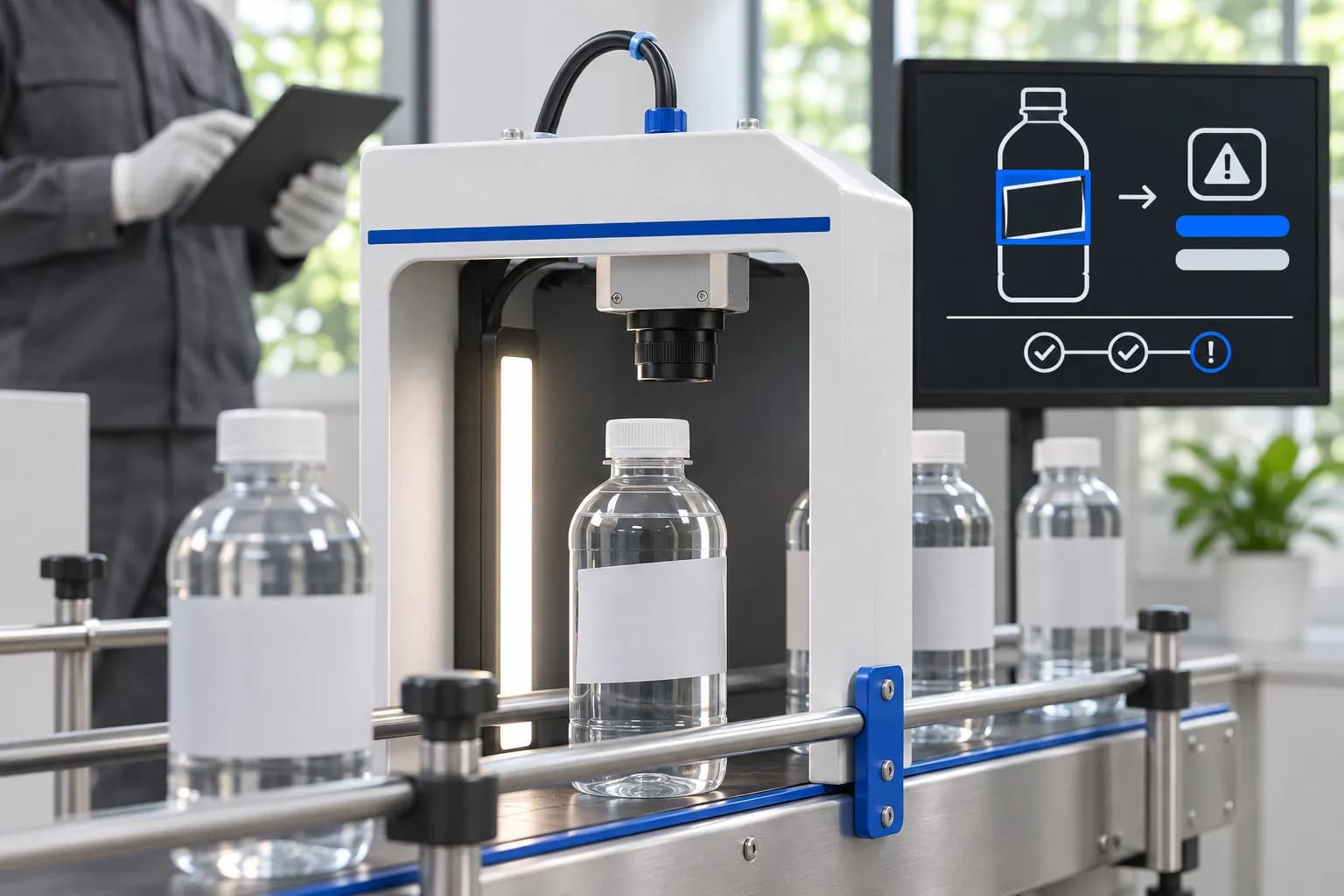
What the starter set includes
The last item is assessed separately for each job; the others are in the starter set. The actual scope is set out in each project proposal.
- A single check point on the packing line, at the position surveyed together
- A checklist for labels, printed codes and caps, agreed with the line supervisor
- A reject or alert signal, linked to the existing mechanism as assessed
- A new reject mechanism, if needed, is assessed separately on site
Further development, per project
These are directions to assess and test per project. They are not part of the starter set.
Read codes against orders
Concept · to be assessed- What it does
- Read the printed date and lot codes and compare them with the production order for that run.
- Benefit
- Helps catch a wrong-run code before the piece leaves the line.
- Must pass before use
- Print sharpness must be tested, and a person must confirm the source of the production order before it is used as the rule.
Check several sides
Concept · to be assessed- What it does
- Add camera angles to view the back, sides and seal of the package.
- Benefit
- Covers areas a single camera angle may not see.
- Must pass before use
- Piece orientation and space beside the conveyor must be tested.
Settings by product code
Concept · to be assessed- What it does
- Store inspection criteria per product code and load them when the line changes model.
- Benefit
- Less manual re-setting when switching models.
- Must pass before use
- Someone must be named to approve each recipe, with a way to confirm the recipe matches the model being packed.
Link lot data to ERP
Concept · to be assessed- What it does
- Send inspection results and lot codes to the customer's existing ERP.
- Benefit
- Keeps inspection data alongside production records.
- Must pass before use
- Data format, access rights and handling of lost communication must be checked.
Compare label art to a master
Concept · to be assessed- What it does
- Compare label artwork and text positions with a master image the customer approves.
- Benefit
- Helps catch wrong-model or misprinted labels against the master.
- Must pass before use
- A master image confirmed by the responsible person is needed, tested on labels printed in different lots.
Sensor confirms rejection
Concept · to be assessed- What it does
- Add a sensor to check that a piece ordered out has actually left the line.
- Benefit
- Shows when the reject mechanism does not complete a command.
- Must pass before use
- Decide whether an unconfirmed reject stops the line or alerts the supervisor, with a person approving.
Comparing ways of working
A comparison of ways of working, not measured before-and-after results.
| Topic | Usual approach | Proposed approach |
|---|---|---|
| Checking | People look by eye, varying by shift | Camera checks the agreed checklist |
| Evidence | Remembered or noted when found | Images and records of failed pieces |
| Rejecting | A person pulls pieces they spot | Signal to a reject mechanism or supervisor |
| Proof | Trust results from other lines | Test on this line's own samples |
Where it fits
Suits packing lines that must check labels or codes on the product and currently rely on people looking by eye.
Limits, and when it does not fit yet
If label designs change often with no recipe management, or pieces sit unevenly, sort out piece placement and the model list first.
What to prove before investing
- 01Real line speed and spacing between pieces
- 02Images of glossy or clear packaging under trial lighting
- 03Good and bad samples whose status the supervisor knows
- 04The existing reject mechanism, and who is responsible for wrong rejects
FAQ
Frequently asked questions
Cannot be assured. Results depend on lighting, piece orientation and packaging condition. Test with real samples first, and have a person review pieces the system is unsure about.
Possibly, but lighting and camera angle must be trialled on the real packaging. Reflections can hide printed text, so the concept image cannot answer this.
Agree this before starting. The customer's line supervisor checks rejected pieces and decides what next. The team is responsible for the settings as agreed.
What to prepare before talking to us
You do not need all of it; start with what you have.
- A list of the machines to collect data from, with the PLC make and model if you know them.
- Photos of the control cabinets and the site.
- The forms or files you record on today.
- For inspection: sample parts or labels, both passes and fails.
Other products in this group
Production data kit and OEE dashboard
See where production time goes, using data that comes from the machine
Cold room and drying room temperature monitoring
Continuous temperature records instead of hand logging, with sensors placed from a room survey
Camera-based part measuring station
Measure repeated parts by camera instead of vernier, once tested on real work
Remote pump and tank level monitoring
See pump status and water levels from afar, without driving out on every round
Per-machine and per-line energy metering
See electricity use by machine and by period, instead of one monthly bill total
Send label samples and line images to start the assessment
Attach photos or video of the packing line, good and bad sample pieces, and the checks you need. The team will then help set what to survey and test first.