By ยศกร จิรพงศานานุรักษ์, Founder · 7 min read · Smart factory
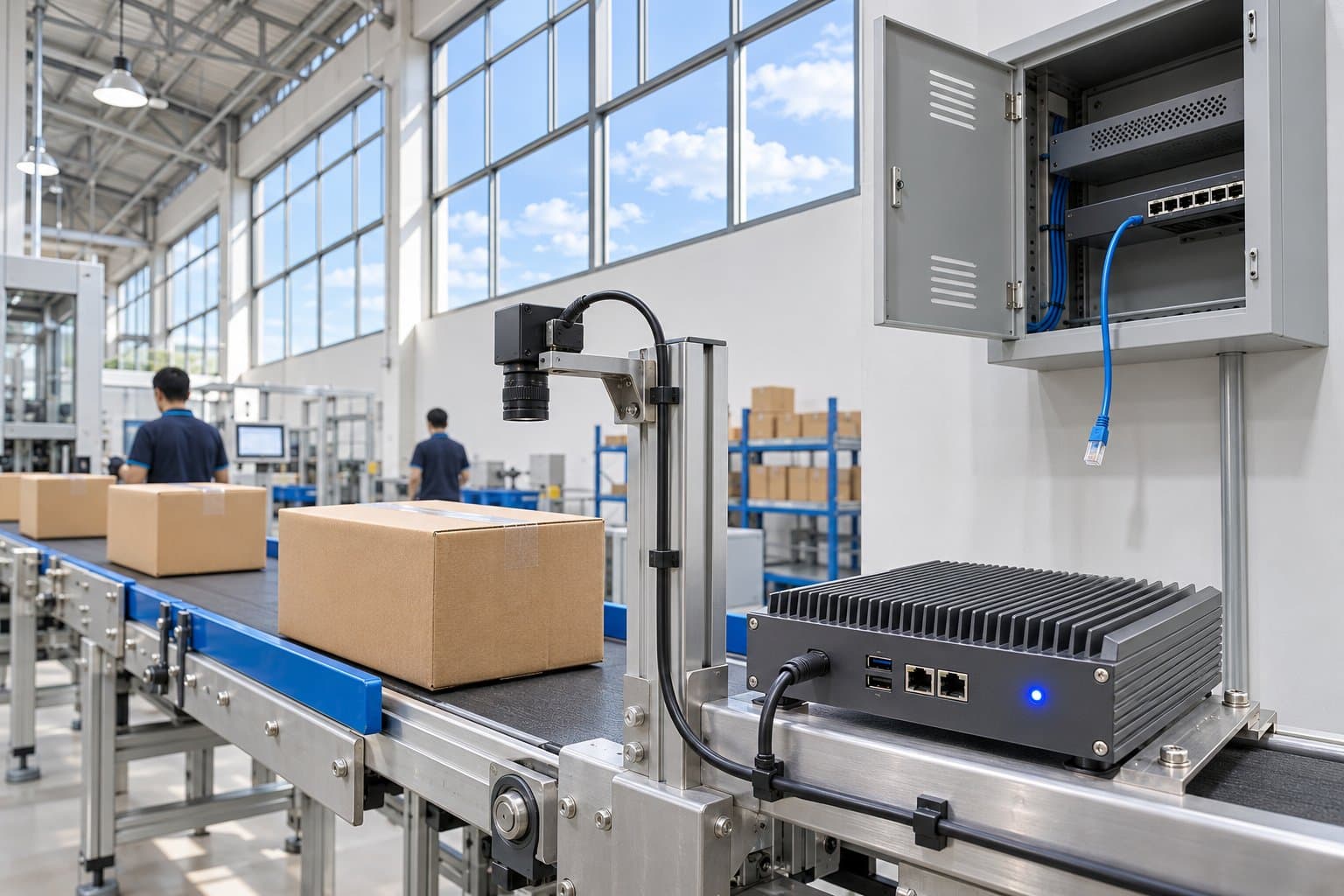
The question that comes up almost every time we discuss an AI project in a factory is whether the data has to go to the cloud. The short answer is that it depends on how fast that task has to make a decision, and what the result goes on to control. If the result has to trigger an air cylinder to blow a reject off the conveyor within a fraction of a second, the cloud is not the answer to begin with.
How do Edge and Cloud differ?
- Edge: processing on a machine installed in the factory, close to the production line. It responds in milliseconds and keeps working even if the internet drops.
- Cloud: processing on external servers. Capacity can scale without limit, and it suits work that combines data from several factories or occasionally needs heavy resources.
Which work must stay at the Edge?
- Defect inspection on a line, where the reject signal must arrive in time with the conveyor.
- Safety-related work, such as stopping a machine when a person is detected entering a danger zone.
- Factories with an unstable internet connection, or that cannot stop production even if the internet goes down.
- Data that company policy or customer contracts forbid from leaving the organisation.
- Work that would send video to the cloud continuously, where the bandwidth cost is not worthwhile.
Which work suits the Cloud?
- Combining OEE and output figures from several factories to view in one place.
- Training new models on large accumulated sets of images, which uses heavy graphics cards in bursts.
- Executive reports and dashboards that must be opened from outside the factory.
- Storing long-term historical data to analyse trends.
The hybrid architecture used in real factories
Most projects do not pick just one. They divide the roles: real-time decisions stay at the Edge, while model training and consolidated reporting sit at a central location. The Edge sends up only summaries and images of interesting cases, not a whole shift of video. When a new model version is ready, it is sent back down to be deployed at the Edge. This pattern gives both speed and the ability to keep developing the model continuously.
A caution that is often overlooked: the word cloud in a factory project does not always have to mean a foreign provider. A central server located in the company's own office can do the same job, and for many Thai factories it often answers the data-policy question better.
Costs that are often underestimated
- Bandwidth and the cost of taking data out of the cloud, which grow quickly with the number of cameras.
- Electricity and heat from Edge machines that have to be installed in a factory environment.
- Long-term maintenance, including model updates and data backup.
- A fallback plan for when the internet goes down, which, if not designed in from the start, turns into a line stoppage.
Frequently asked questions
How powerful does the Edge machine need to be?
It depends on the number of cameras, the image resolution, and the pieces per minute to be inspected. A single-point, medium-speed inspection can use a small machine that fits in the control cabinet. Multi-camera, high-speed work is when you move up to a machine with an accelerator card. Calculate from the real requirement before choosing specifications.
If we want to move to the cloud in future, will it be hard?
Not if it is designed in separate parts from the start, with the model and the data connector as separate pieces. Moving where the processing happens then becomes a change of the data's destination, not a rewrite of the whole system.
If the internet goes down, does an Edge system really keep working?
Yes, if it is designed so that the Edge can make every decision by itself and keep data on the machine while it cannot send, then send it in batches when the internet returns. This should be written in as a requirement at the design stage, not fixed afterwards.