By ยศกร จิรพงศานานุรักษ์, Founder · 6 min read · Machine vision
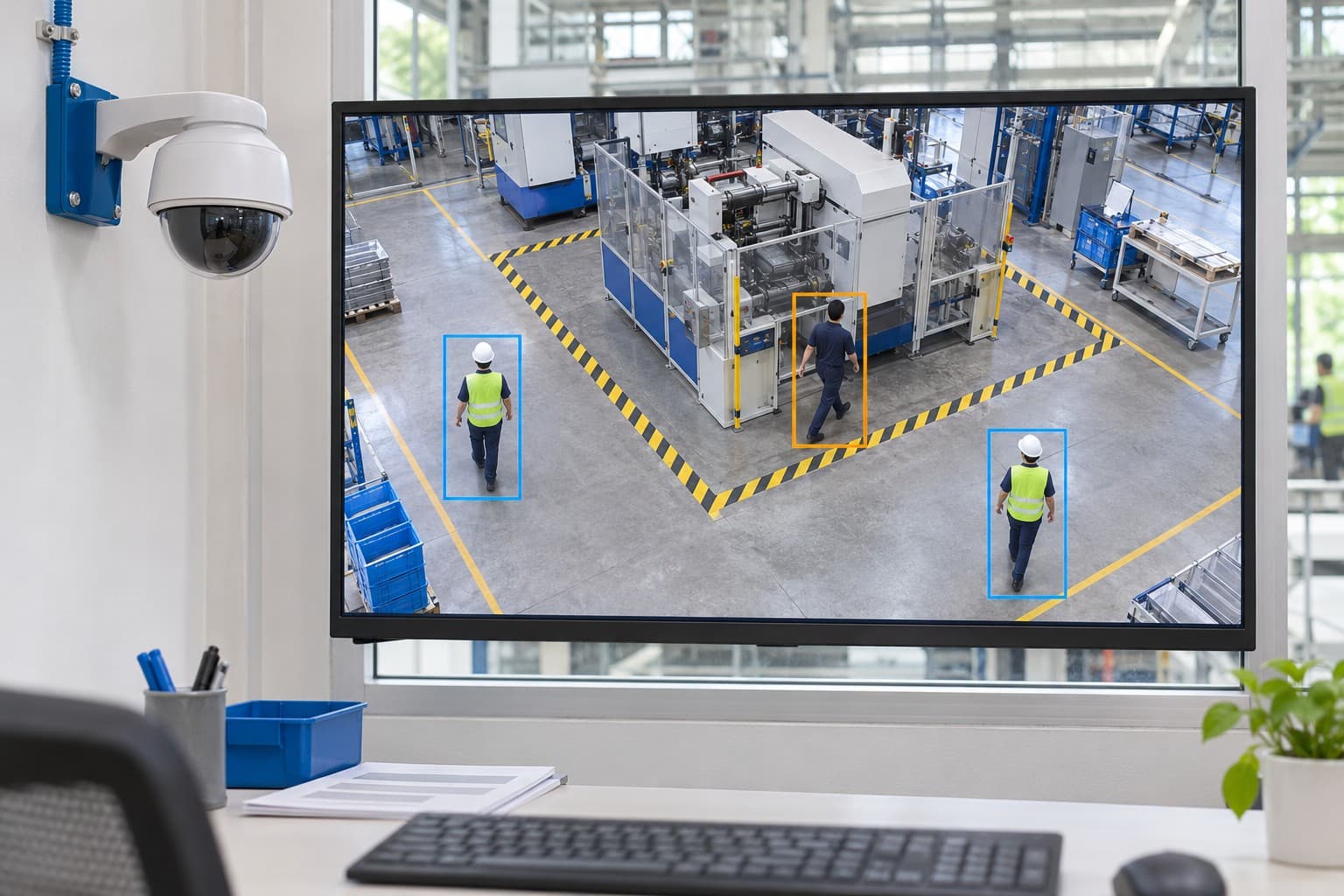
Most factories already have CCTV cameras everywhere, but the footage is only really viewed after something has happened. Safety AI turns cameras that were used for looking back into a system that can warn before anyone is hurt.
What can the AI detect?
- Wearing of protective equipment, such as safety helmets, reflective vests, glasses and gloves.
- Entry into restricted zones, or zones where a robot is working.
- Standing closer to a machine than the defined safe distance.
- Forklifts travelling off their defined routes, or faster than they should.
- A person falling or being abnormally motionless in an area where someone works alone.
Can you use the existing CCTV cameras?
Many points can be used immediately, provided the camera sees the whole person and the resolution is enough to tell details such as a safety helmet. But cameras mounted very high and looking almost straight down, or cameras that face window glare every afternoon, usually need to be repositioned or given extra lighting. A site survey beforehand therefore saves a lot, because you know from the start which points can use the existing cameras and which need extra investment.
Employee privacy
This is an issue that makes projects fail more often than technical problems do. The approach that works in practice is to design the system to detect where and when a violation happened, without needing to identify who it was. Do not enable facial recognition, blur faces in stored images, set a short retention period, and notify employees in advance, explaining that it is for safety and is not used to assess individual performance.
A caution: if employees feel the system was installed to catch them out, it will be resisted and worked around until it has no value left. Successful projects usually start by talking with the safety department and employee representatives before installation, and then use the results as aggregate figures for an area, not a list of individuals.
How do you measure whether it is worth it?
Do not measure by the number of alerts, because the more sensitive the setting, the more alerts there are, which does not mean it is any safer. Measure the trend in the violation rate per number of people entering the area, the number of near-miss events that get recorded, and the time taken to respond after an alert. These figures can also be used to negotiate insurance premiums and to answer auditors from major customers.
Frequently asked questions
Will the system raise many false alerts?
It depends mainly on camera angle and lighting. Spots with backlight, or where people constantly block each other, will give more false alerts. To reduce them, start with a few points with good image conditions, tune until stable, and then expand. This is better than switching on the whole factory at once and being flooded with alerts that nobody pays attention to.
Should the system stop the machine directly?
In most cases, no. Work that requires stopping a machine for safety should use safety devices certified to standards, such as safety light curtains or area scanners. Camera-based AI suits a monitoring and alerting role better. The two can complement each other but cannot replace each other.
Does the image data have to leave the factory?
Not necessarily, and for this kind of work we recommend processing entirely inside the factory, because the images contain people. Storing and processing internally makes access easier to control, which helps when planning for PDPA.