By ยศกร จิรพงศานานุรักษ์, Founder · 26 min read · Machine vision
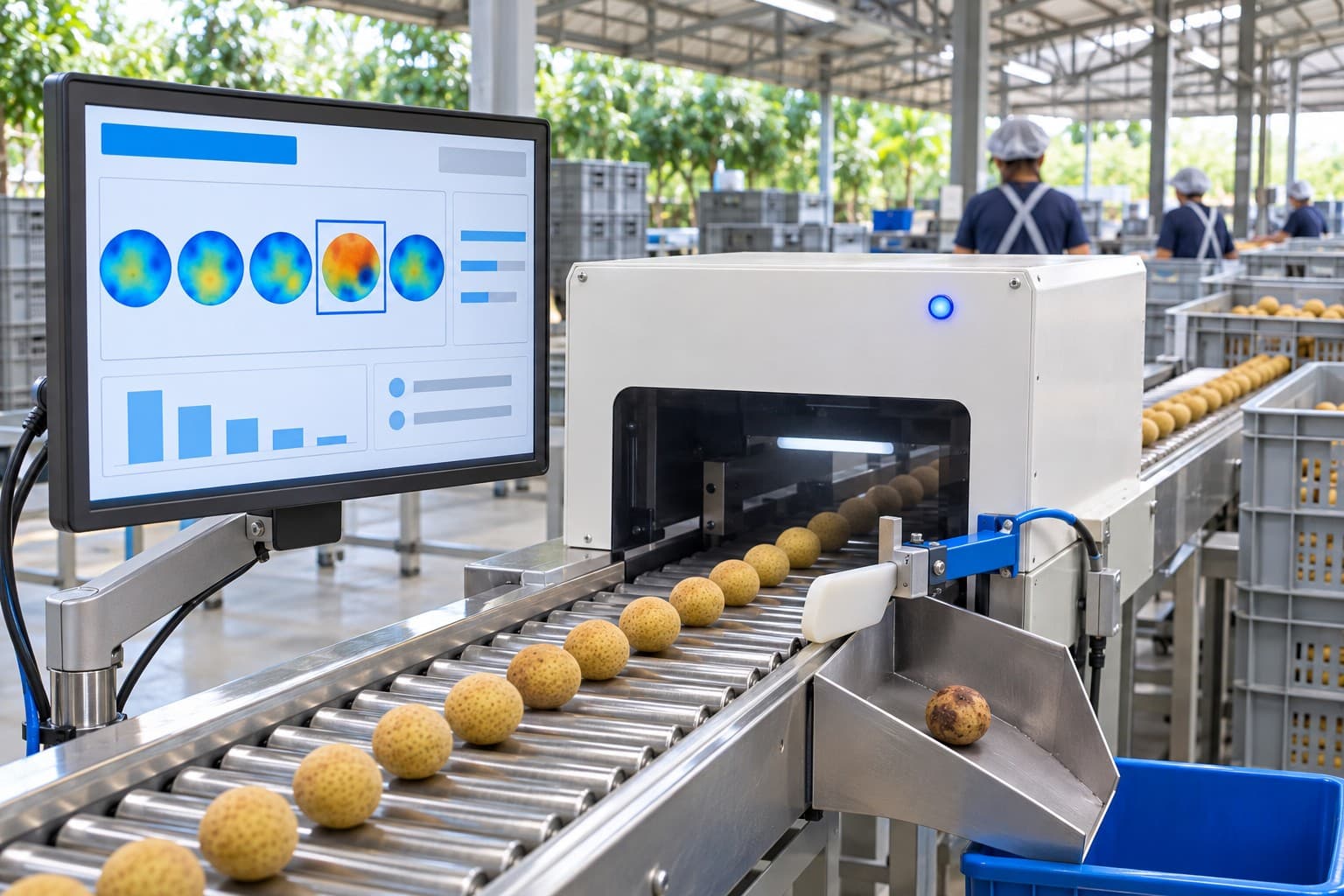
AI fruit sorting is a system that uses industrial cameras (including hyperspectral cameras) together with AI to analyse the quality of each fruit on a conveyor, such as ripe versus unripe, surface defects, size, colour and sweetness, and then automatically rejects what does not pass. Its strengths are that it works fast, is consistent, and can see internal quality that the human eye cannot. Whether it suits a given packing house depends on validation. It can suit fruit packing houses and packing plants that must export to standard.
Why do fruit packing houses and factories need AI sorting?
- Hand sorters cannot keep up in the peak season, and the standard differs from person to person.
- Export markets (China/Europe) have strict quality standards and traceability requirements.
- Even a few unripe durians or defective fruits slipping through can spoil a whole lot and damage the name.
- Labour costs are rising and sorters are getting harder to find every year.
How does AI fruit sorting work? Three steps
- Image capture: fruit passes along a conveyor under RGB and/or hyperspectral cameras, with lighting designed specifically for the purpose.
- AI analysis: the model assesses colour, size, surface defects and internal quality (for example % starch/sugar) from the spectral signature.
- Automatic sorting: the system commands an actuator/robot arm to blow or push fruit that fails off the line, separating by grade in real time.
How does hyperspectral differ from an ordinary camera?
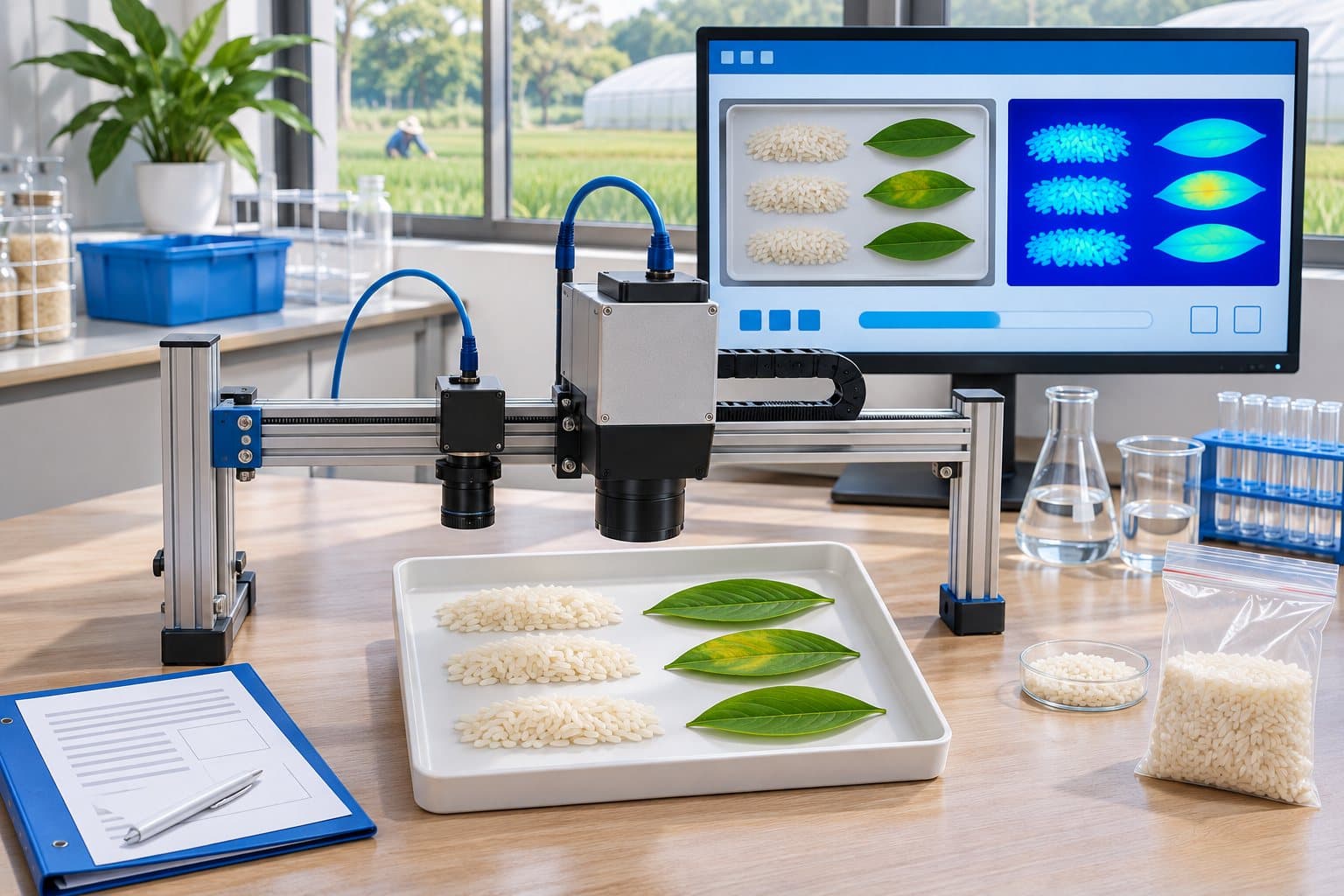
An ordinary (RGB) camera sees only the colour of the outer skin, but a hyperspectral camera captures hundreds of bands of light, so it can read the fruit's 'spectral signature'. It can therefore assess ripeness, starch/sugar content, moisture, or internal abnormalities (such as core flesh or water-soaked pulp) that neither the human eye nor an ordinary camera can see, without cutting the fruit open.
A clear example is measuring the % starch of durian to tell how immature or mature it is before cutting or export, which used to rely on tapping and listening to the sound, or cutting open random samples.
Which fruits can it be used with in Thailand?
- Longan: grading by size and defects for export.
- Durian: assessing immaturity or maturity (% starch) and defects (for example at fruit packing houses in Chanthaburi/Chumphon).
- Tomato / lime: sorting by colour, ripeness and surface defects.
- Other export fruits: rambutan, mangosteen and longkong, according to customer specifications.
Is it worth it, and who is it suited to?
It suits best the fruit packing houses and packing plants with high volume that must export to standard, because it reduces the amount of defective fruit that reaches the destination, reduces claims, and can run around the clock. To begin, you should assess the type of fruit, the volume and the destination standard first, so that you choose the camera and model that give the best value.
Frequently asked questions
Is AI fruit sorting really more accurate than people?
For work with clearly defined criteria, such as size, colour and surface defects, AI can be more consistent than people and does not tire. For internal quality (ripeness/starch), hyperspectral provides information that the human eye cannot assess. That said, accuracy depends on good training-data collection and correctly designed lighting.
Do you have to cut the fruit open to check it?
No. Hyperspectral measures internal quality non-destructively, so every fruit can be inspected without wasting any, although the readings are estimates that must be checked against reference measurements.
Can it be installed on an existing sorting line?
In most cases it can be added onto the existing conveyor, by adding camera stations, lighting and a sorting mechanism, and connecting the signals to the existing PLC.
References
- Advancement of non-destructive spectral measurements for the quality of major tropical fruits and vegetables: a review (Frontiers in Plant Science, 2023) (accessed 2026-11-21)
- Application of Near-Infrared Spectroscopy and Hyperspectral Imaging Combined with Machine Learning Algorithms for Quality Inspection of Grape: A Review (Foods) (accessed 2026-11-21)