6 min read · Machine vision
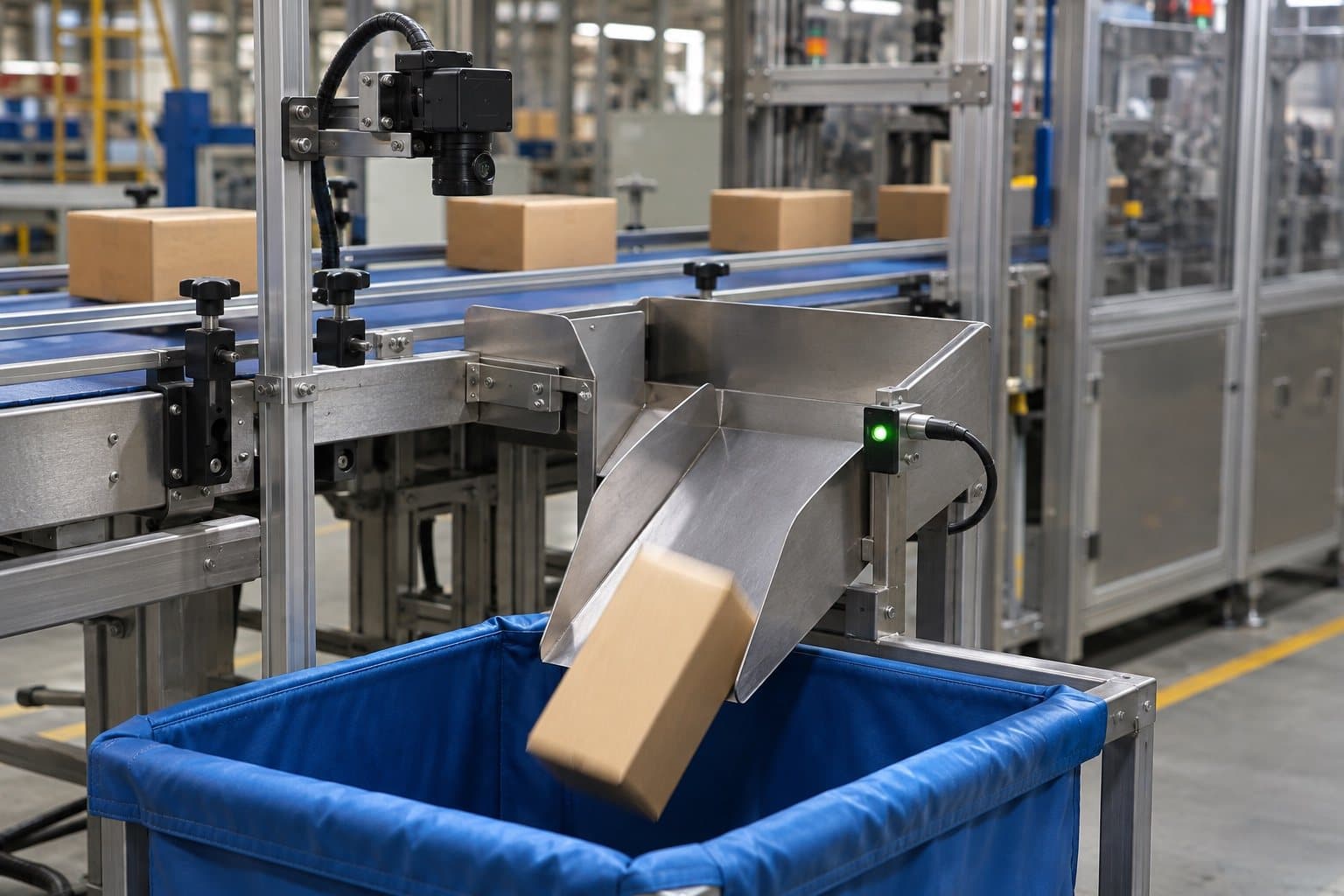
A vision system finds a defect and commands the rejector to take it off the line. It sounds finished, but sending the command does not prove the part actually fell into the reject bin. If the bad part stays on the chute, bounces back onto the conveyor, or the bin is so full it overflows, defects may flow in with good product while the system believes the reject succeeded. The examples in this article are hypothetical.
A reject command is not the same as a successful reject
The signal the PLC sends to the rejector, such as an air cylinder, an air-blast nozzle or a pusher arm, only says that the command was given. It does not say whether the part reached its destination. The real outcome can differ in several ways.
- A light part is not blown hard enough and falls beside the conveyor instead of into the bin, or rolls back onto the line.
- The part bounces off the edge of the bin or the chute and flies out.
- The part sticks in the chute and the next parts pile up behind it.
- The bin is full, and new parts land on top or spill over.
- The bin has been removed to be emptied and not put back, so rejects fall on the floor.
- The rejector is slow or stops halfway, so its timing misses the part.
What to add: a confirmation signal at the bin
- A sensor that detects a part falling past the mouth of the bin or the chute exit, for example a through-beam photoelectric sensor that sends a signal when it sees a part pass.
- A sensor that checks the bin is in position. If there is no bin, the system must stop rejecting or raise an alert.
- A level sensor or counter to warn before the bin is full, measuring level, counting parts, or both.
- A sensor to detect a blocked chute. If the signal stays blocked for an abnormally long time, a part may be stuck.
- A time window: after the reject command, how many milliseconds the confirmation signal may take to arrive and still count as success. This value comes from measurement on the real line.
Choosing and installing the sensors depends on the type and size of the part, belt speed, dust and humidity, and hygiene requirements on a food line. Test with real parts before putting it into use.
Match the counts: reject commands against what the sensor sees
The system should keep two counts side by side: the number of reject commands, and the number of parts the bin sensor saw fall into the bin. If the two drift further apart, some parts were commanded to be rejected but did not reach the bin. Alert the supervisor, and record the part number or time of each unconfirmed part so you can trace later where it went.
Matching a command to each individual part requires the same part number all the way from the camera to the rejector. See the article on sending camera inspection results to a PLC for details.
What to do when there is no confirmation signal
Decide in advance what the system does when a part is not confirmed. The safe approach is for the system to be fail-safe: when in doubt, take the option with less damage.
| Situation | What the system should do | Who follows up |
|---|---|---|
| Reject commanded but no confirmation within the time window | Alert, record that part, and divert or stop as defined | Operator checks the chute and bin |
| Bin nearly full | Give advance warning so it is emptied before it fills | Operator |
| Bin full or missing | Stop rejecting, and stop or divert the line as designed | Operator fixes it and presses reset |
| Chute blocked, signal blocked for abnormally long | Alert, and stop the line if necessary | Technician or operator clears it |
| Reject command count and bin count drift apart | Alert the supervisor and record it for review | Shift leader or quality department |
Designing the line stop, access to the chute or bin, and protection from machine hazards is the job of a qualified engineer or safety specialist. Never bypass or disable safeguards to keep the line running.
Common mistakes
- Treating a reject command as a successful reject, with no confirmation signal.
- Setting the time window by guessing instead of measuring, causing frequent false alarms or missing parts that do not reach the bin.
- No sensor to check whether the bin is present.
- Warning only when the bin is already full, not in advance.
- Turning off the alert because it fires often, instead of finding the cause.
- Not testing with parts that are light, sticky or wet, which are the ones most likely to bounce or jam in the chute.
Hypothetical example: a plastic parts inspection line
Suppose a line inspects small plastic parts and uses an air-blast nozzle to reject defects into a bin. The bin holds 150 parts, with a warning set at 120. In one shift, the system commands 96 rejects, but the sensor at the mouth of the bin sees 93 parts fall in, leaving 3 unconfirmed (96 − 93 = 3).
The system alerts and records the numbers of those 3 parts. The operator checks the chute and finds one part stuck under the chute and two that bounced out sideways. The team adjusts the angle of the chute and adds a splash guard, then collects count comparisons over several more shifts. As for the bin, when the count reaches 120 the system tells the operator to empty it, so it never gets to 150. Without the count comparison, those 3 bad parts could have gone in with the good ones without anyone knowing.
Limits and cautions
A sensor at the mouth of the bin tells you that a part passed, but not that it is the same part that was commanded to reject, especially when several parts pass at once. A more complex system needs additional design. Sensors can also fail or get dirty, so they have to be tested and cleaned on a schedule. The figures in the example, such as 96, 93, 150 and 120, are all hypothetical. The time window and the way the line stops must be set from trials on the real line and according to the plant’s safety requirements.
Starting references
- Wikipedia — Fail-safe
- Wikipedia — Photoelectric sensor
- Wikipedia — Automated optical inspection