6 min read · Smart factory
Many factories record changeover time from the moment the machine stops until it starts running again. That sounds reasonable, but a machine that has started running is not yet producing good product. It usually still needs adjusting and several trial pieces, so that time drops out of the figure.
A more useful definition is to count from the last good piece of the old product to the first good piece of the new product. The example here is hypothetical.
Why count to the first good piece
Customers and the production plan care about when the first good piece arrives, not when the machine turns. If you count only to machine start, adjustment time and trial pieces fall into production time or are counted as scrap, which distorts both changeover time and quality.
Measuring to the same definition also lets you compare shifts and machines, and see which part takes the most time.
Separate the work that can be done while the machine runs
The SMED (Single-Minute Exchange of Die) approach splits changeover work into two kinds. Internal work must be done while the machine is stopped, for example removing and fitting the tooling. External work can be done while the machine is still producing the old product, for example preparing tools and materials and pre-heating the new tooling. Moving external work to before the stop often cuts time without buying anything.
- Define the start and end clearly: the last good piece of the old product and the first good piece of the new product, according to criteria set by quality.
- Time one or two real changeovers, recording each sub-task with its time. If possible, record video for review.
- Classify each task as internal or external. Ask whether it really has to wait for the machine to stop.
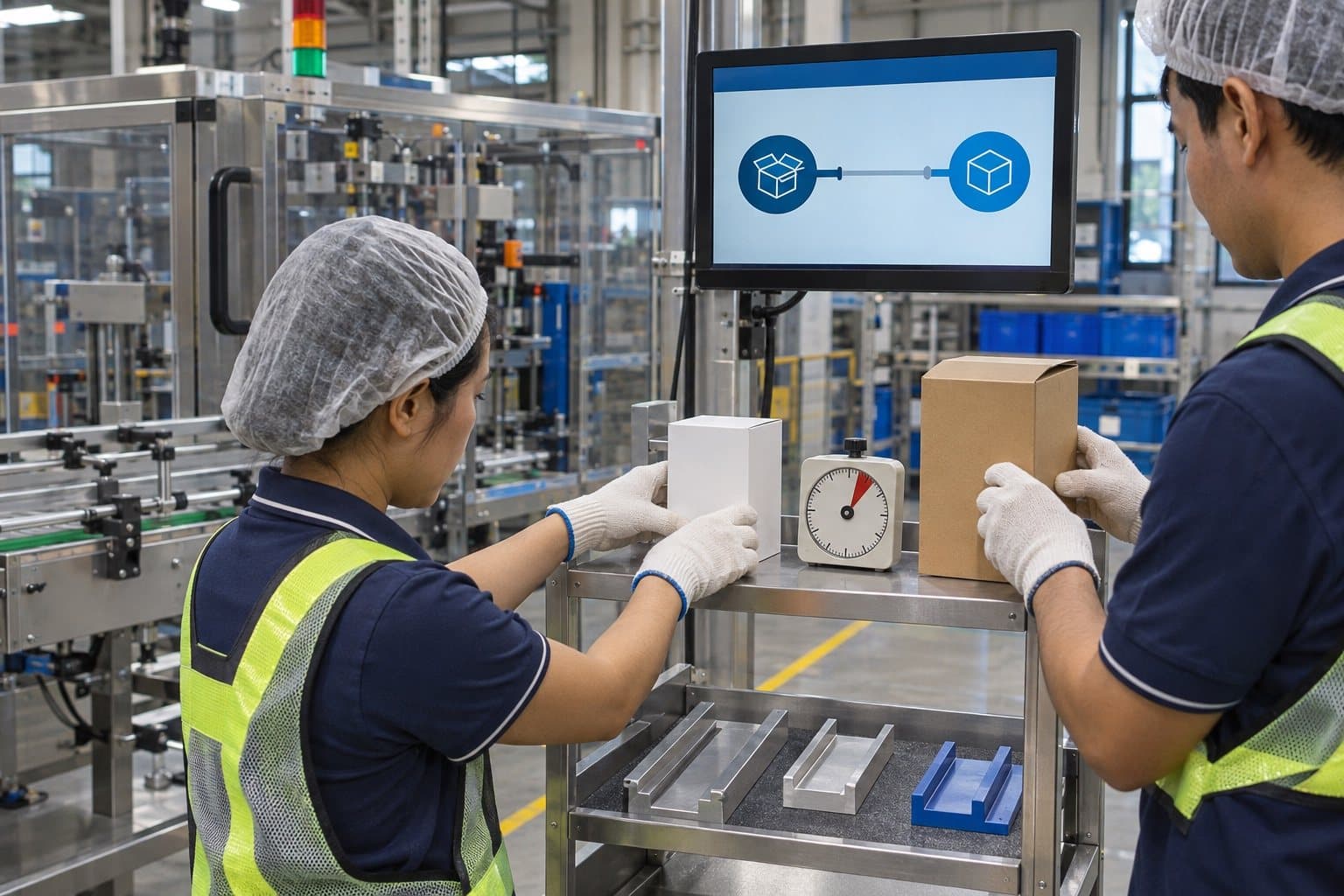
- Move external tasks to before the stop, and set the tools ready on a trolley or table beside the machine.
- Look at adjustment and trial pieces: can recorded setpoints reduce trial and error?
- Measure again and compare with the previous time. Store the values in the system with a changeover reason code.
| Sub-task | Type | When | Caution |
|---|---|---|---|
| Prepare tools and materials | External | Before the machine stops | Use a checklist so nobody has to go back for something |
| Pre-heat the new tooling or format set | External | Before the machine stops | Follow the manufacturer's method and safety rules |
| Remove and fit the format set | Internal | While the machine is stopped | Lock out energy according to the plant's safety procedure |
| Clean for the new product | Internal | While the machine is stopped | Follow the product standard; if allergens are involved, quality decides |
| Adjust and run the first trial pieces | Internal | After installation | Record the settings that worked, to cut repeat trials next time |
Common mistakes
- Counting to machine start, so trial pieces end up in production time or are counted as scrap.
- Moving work earlier without checking that it is safe, for example pre-heating tooling next to a machine that is still running.
- Not defining what counts as the first good piece, so each shift judges it differently.
- Cutting time so far that the cleaning or quality check steps get skipped.
Hypothetical example: a carton packing line
Suppose one changeover takes a total of 54 minutes from the last good piece to the first good piece, split into: preparing tools and materials 10 minutes, pre-heating the new format set 6 minutes, removing and fitting the format set 18 minutes, cleaning 8 minutes, and adjusting and running the first trial pieces 12 minutes (10 + 6 + 18 + 8 + 12 = 54).
The first two tasks are external, 10 + 6 = 16 minutes in total, and can be moved to before the machine stops. Changeover time falls to 54 − 16 = 38 minutes, a reduction of about 30% (16 ÷ 54 ≈ 29.6%).
With 5 changeovers a week, that cuts machine stoppage by 5 × 16 = 80 minutes a week, or 1 hour 20 minutes.
Limitations and cautions
All numbers in the example, including 54, 38 and 16 minutes and 5 changeovers a week, are hypothetical. In your own work you may be able to move more or less out, and some tasks have safety or quality requirements that forbid moving them.
Cleaning steps, energy lockout and the criteria for a good piece must follow the plant's standards and your auditors' requirements. Reducing time should not come at the cost of safety or quality.
Starting references
- Wikipedia — Single-minute exchange of die
- Wikipedia — Total productive maintenance