6 min read · Smart factory
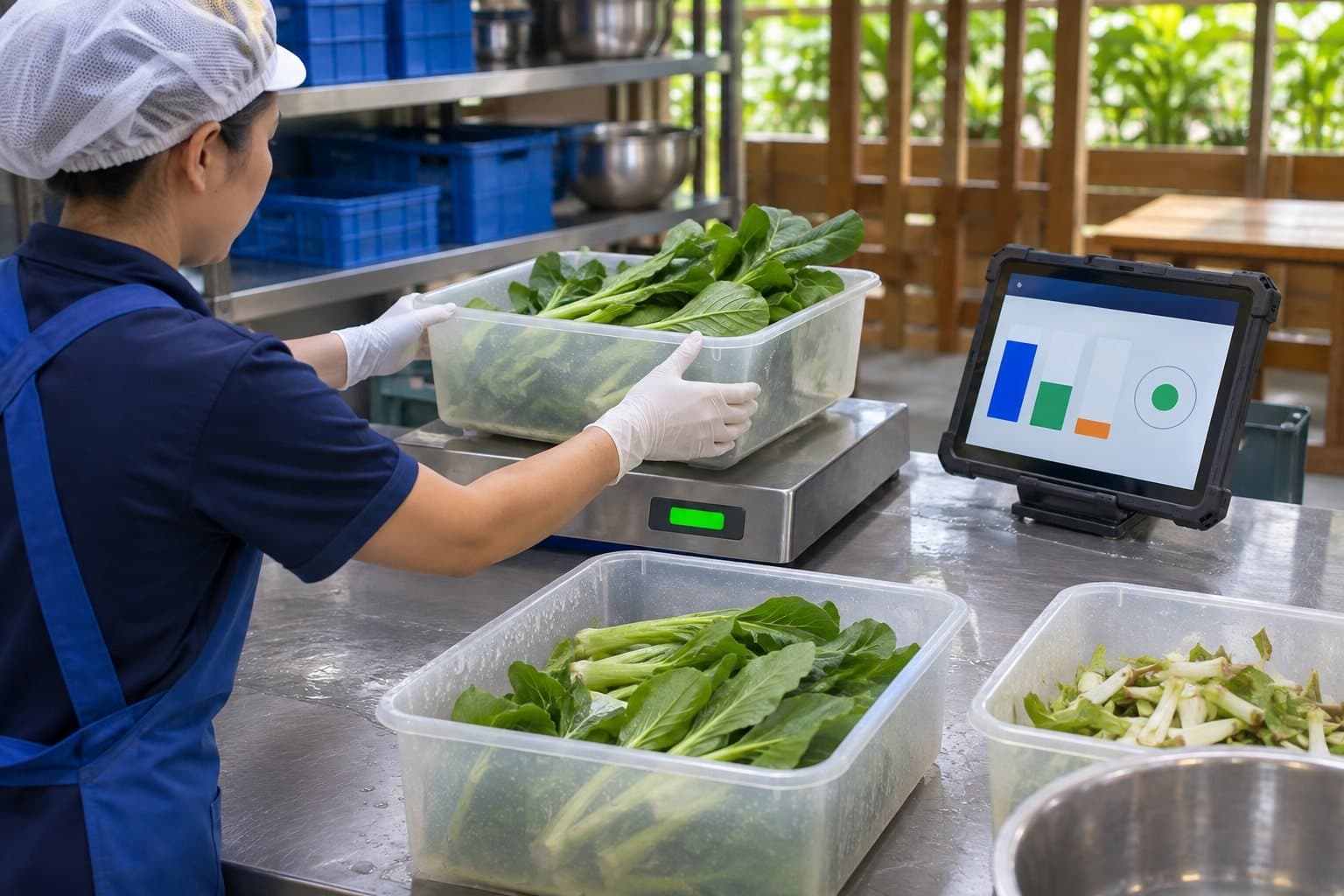
Suppose 1,000 kg of raw material goes into a batch. The good product you can pack is already less than 1,000 kg, because there are trimmings, evaporation and spills. The question is whether everything that went missing has a known source. A batch mass balance puts the weight in, the weight out and the recorded losses side by side, so you can see how much is left unexplained.
The example in this article is hypothetical. Every number is there only to explain the method, and none is a reference value for any industry or factory.
What a batch mass balance is
The idea is short: weight in equals good product, plus recorded losses, plus the unexplained part.
Yield is good product divided by weight in. The unexplained part is what you have to follow up, because it can hide several kinds of problem, such as a drifting scale, missing records, or product that went somewhere nobody intended.
The weight-in side must count everything that was added, including water and additives, not just the main raw material. Otherwise the input is lower than the true figure and the yield looks better than it is.
Doing the mass balance step by step
- Define the batch boundary clearly: where counting starts and where it ends. Product left in pipes or holding tanks needs a rule for which batch it is counted in.
- Weigh every input, including water and additives, and record it with the batch number and time.
- Define the loss categories in advance, for example trimmings, moisture evaporated, spills and wash water, samples sent for testing, and rejected product, and write down how each category is measured.
- Weigh the output, separating good product from rejects. Use a verified scale and deduct the container weight (tare) correctly each time.
- Calculate the difference for each batch and look at it as a share of the weight in.
- Set the threshold for the unexplained part from that line's own historical data, not from numbers in an article or from another plant.
- If a batch exceeds the threshold, check the items in the next section before releasing the next batch.
How to measure each loss category
| Category | How to measure | Caution |
|---|---|---|
| Trimmings or peelings | Weigh that batch's waste bin and deduct the bin weight | Do not tip waste into a shared bin before weighing |
| Moisture evaporated | Weigh before and after the drying or boiling step, on the same scale | Hot and cold weights differ, so fix the weighing point |
| Spills and wash water | Weigh the collecting container, or estimate from volume and density | This has the highest uncertainty, so record how it was estimated |
| Samples sent for testing | Weigh them, or count them and multiply by the average weight | Unrecorded samples are a common cause |
| Rejects and rework | Weigh in separate containers, labelled with the batch number | Reworked product returned to the line must not be counted as input twice |
When there is an unexplained part, how to chase it
- Scale: compare against standard weights at the plant's calibration interval, and check that the set tare weight is still correct.
- Mixed units: kg versus litres, or kilograms versus bags counted as pieces. Check that every point uses the same unit.
- Missing records: look for additions or withdrawals that were not logged against a batch number.
- Batch cut-off: product left in pipes or holding tanks was counted in the previous or the next batch.
- Rounding: rounding each item and then adding can differ from adding first and then rounding.
- Timing: weighing at different times. Wet or hot product changes weight by itself.
Check the weighing and recording system before looking for someone to blame. Most of the unexplained part comes from how things are measured and written down, not from anyone's intent.
Common mistakes
- Calculating yield from a weight in that leaves out water and additives, which makes the figure look better than it is.
- Using moisture values from a recipe or textbook instead of weighing every batch.
- Setting one threshold for every product, even though the process and the losses differ.
- Having only a daily total with no breakdown by batch and shift, so you cannot tell when the problem happened.
- Not recording why a batch exceeded the threshold, so the same problem comes back.
Hypothetical example: one batch of a processed product
Suppose a line peels, cuts and boils. This batch has 1,000 kg of raw material and water in total. All of the following figures are hypothetical.
| Item | Weight (kg) | Share of weight in |
|---|---|---|
| Weight in | 1,000 | - |
| Good product packed (yield) | 872 | 87.2% |
| Peelings and trimmings | 60 | 6.0% |
| Water evaporated while boiling | 38 | 3.8% |
| Spills and wash water | 7 | 0.7% |
| Samples sent for testing | 3 | 0.3% |
| Total explained | 980 | 98.0% |
| Unexplained | 20 | 2.0% |
Check the arithmetic: 872 + 60 + 38 + 7 + 3 = 980 kg, and 1,000 − 980 = 20 kg, which is 2.0% of the weight in.
Suppose the team had previously set the unexplained threshold at no more than 1.0%, based on this line's historical data. This batch exceeds it and must be investigated. Suppose the check finds that some of the trimmings were tipped into the shared bin before weighing, so the recorded trimmings were lower than the true amount. The team adds a rule to weigh the trimmings bin before tipping every time, then watches the next batches to see whether the unexplained part goes down.
Limitations and cautions
- All numbers in the example are hypothetical. A real threshold must be set from the data of your own line and product.
- A mass balance tells you whether the weights add up. It does not tell you whether the product is of good quality or safe.
- Moisture and spills are hard to measure. Part of the unexplained amount may be measurement error, not a fault.
- A mass balance does not replace batch traceability and does not replace the quality department's inspections.
- If the product is subject to food or other legal requirements, consult your quality department or auditor.
Starting references
- Wikipedia — Mass balance
- Wikipedia — Yield (chemistry)